 La fédération
 Intranet



Projet BIOMASP+
BIOgenic emissions, chemistry and impacts in the Metropolitan Area of São Paulo
Coordinated by Agnès BORBON (LaMP)
Equipes IGE impliquées :
CHIANTI : JL Jaffrezo, G Uzu, V Jacob, S Houdier
HyDRIMZ-STRIM : JMF Martins
ST : A Crouzet, L Jullien, C Voiron
In the last fifty years, the number of megacities has increased by more than ten times leading to a total of 30, and housing more than half of the world’s population. Among the significant challenges facing these regions, air pollution is among the top of the list, accounting for over 5 million deaths per year worldwide, PM 2.5 being the leading cause (HEI State of Global Air, 2019). While the anthropogenic nature of air pollution has been considered for a long time, there is a growing body of evidences that the mixing between human-made emissions and those from the biosphere would modify, and even, exacerbate, the environmental and health effect of anthropogenic pollution. The effect of biosphere- atmosphere interactions would gain importance in the context of emission reduction from traditional mobile sources and global warming that will enhance biogenic emissions at global scale (Peñuelas and Staudt, 2010 ; Lin et al., 2016). The Metropolitan Area of São Paulo (MASP) in southern Brazil is emblematic of those interactions and threats :
– MASP is among the ten largest megacities in the world and, despite the advance of pollutant emission control, is still experiencing air quality problems due to both ozone and particulate matter (PM 10 and PM 2.5) (Carvalho, et al., 2015). Despite the success of the pollutant emission control policy on anthropogenic Volatile Organic Compounds (VOC), the maximum ozone concentrations have remained relatively constant over the last 15 years (CETESB, 2019). This worrying situation raises the question of the role of biogenic VOCs as one of its major precursors (Orlando et al., 2010).
– The presence of green urban forest inside the city and surrounded by the Atlantic forest (Mata Atlantica) (540 km2) corresponding to 30% of the total MASP territory.
– MASP is characterized by a subtropical climate favoring biogenic emissions and photochemical processes. The modelled emission fluxes of isoprene and terpenes, ones of the key biogenic VOC (BVOC), from the vegetation of Brazil are expected to be up to 3 orders of magnitude higher than the ones from temperate latitudes (Sindelarova et al., 2014 ; http://eccad.aeris-data.fr)
– One recent study revealed that the primary biogenic fraction of PM 10 mass in MASP would be as significant as vehicular emissions (11% against 8%) (Emygdio et al., 2018).
By taking MASP as a target natural laboratory, the Franco-Brazilian project BIOMASP+ is a unique opportunity to reduce gaps in our understanding of the atmospheric processes resulting from the complex anthropogenic and biogenic urban mixing. This is needed to properly quantify the impact of pollutants on air quality, health and climate change. The main objective of BIOMASP+ is to evaluate the impact of biosphere-atmosphere interactions on gaseous and particulate urban pollution in a changing climate by addressing the following questions :
• How does the biosphere-atmosphere interaction affect the ozone production ?
• How does this alter the secondary organic aerosol (SOA) formation and aging ?
• How does this affect health and, in return, the biosphere ?
Addressing those questions requires a full knowledge of the nature and intensity of the chemical and biological compounds emitted by the Atlantic Forest. While there have been several studies dedicated to characterize biogenic VOC from the Amazonian rainforest (e ;g. Yanez-Serrano et al., 2015), the emissions of Atlantic forest trees, which are the native trees present in São Paulo state and in MASP, have been completely neglected (Carvalho et al., 2015). They form the Atlantic Forest located along the seashore in the south-eastern part of MASP, distant around 50 km as well as its remnants inside the urban area. The knowledge gained from studies on other neotropical forests such as the Amazon cannot be extrapolated, because of its great biodiversity, largely composed of endemic species. The quantification of the Atlantic Forest tree emissions is one of the original prerequisites of BIOMASP+.
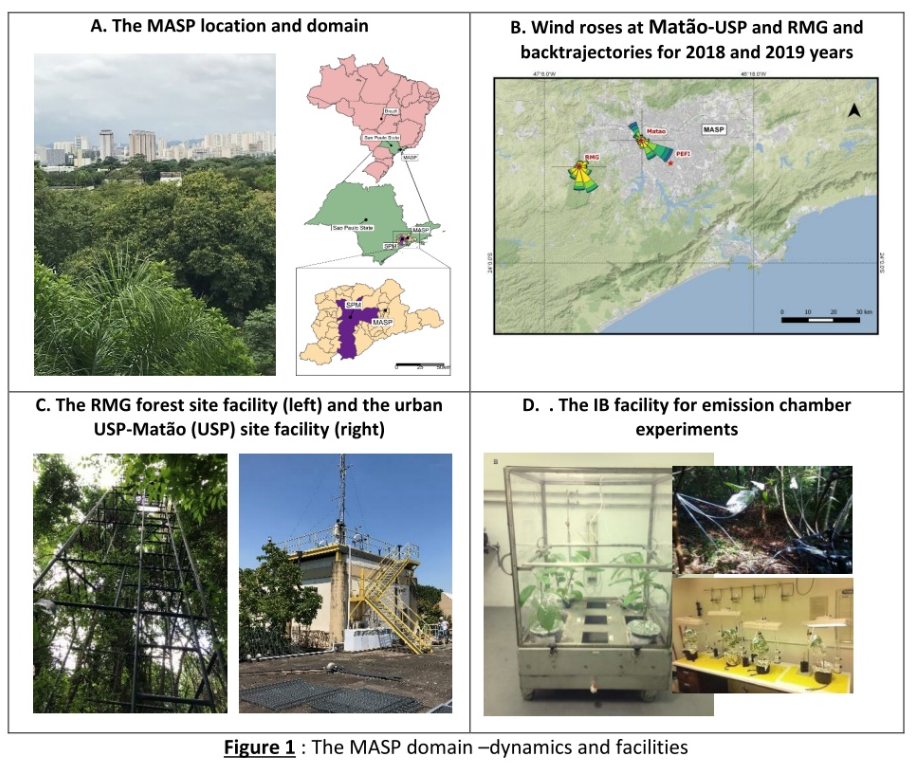
To achieve its main objectives, BIOMASP+ has been designed as (i) an integrative project combining new in-situ and laboratory observations and modelling (ii) a multidisciplinary project because the study of the biosphere-atmosphere interactions implies shared expertise in biogenic emissions, atmospheric chemistry, biology and meteorology. Moreover, the study of the biosphere-atmosphere interactions involves multiple nested spatial and temporal scales : from the leaf level to the above-canopy level, short time to multi-year scale.
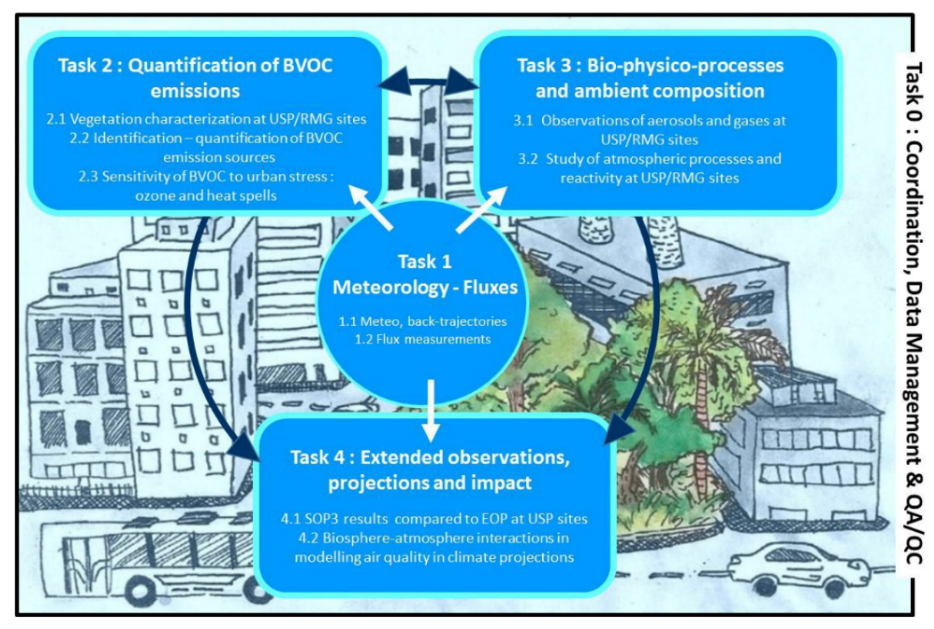
Facing those challenges, we believe that many assets insure achieving our objectives, including :
– The BIOMASP+ consortium (i) is complementary in terms of expertise and technical means (ii) is multidisciplinary by gathering meteorologists, atmospheric chemists and biologists from Brazil and France (ii) already has a well-established collaborative network through national and European projects for the French groups (e.g. MEGAPOLI in 2009, BIOMAIDO in 2019), through the previous BIOMASP bilateral project (2018-2019) and exchanging visits between since 2015.
– The contribution of the local Brazilian groups and the proximity of the experimental sites will facilitate the continuity of the measurements during the whole year and field work success.
The project is innovative through (i) quantification of semi-volatile compounds on a sub-tropical megacity and assessment of their role on SOA formation (ii) the first quantification of the oxidative potential of PM in mixed anthropogenic and biogenic tropical urban environments as a proxy used for assessing health impacts (iii) the quantification of primary biogenic organic aerosol (PBOA) in an anthropogenic-biogenic mixed tropical environment (iv) the first detailed characterization of the Atlantic forest : one of the most poorly described tropical vegetation with respect to VOC emissions.
Publication :
Borbon A., A. Fornaro, A.P. Oliveira, S.R. Souzac, J.F. de Brito, J-L. Jaffrezo, M. Staudt, R.Y. Ynoue, G. Codato, M.P. Sánchez, L.C. Silveira, L. Rizzog, F. Anselmo-Moreira, E. Brugère, P. Fombelle, M. Rocco, L. Domingues, S.
Carbone, E.L.E. Catharino, A. Colomb, J. Florêncio, A. Gandolfo, M. Jamar, J. Kempf, A. Nascimento, O. Muran, J.E. Petit, D.C. Zacharias, J. Wu, A. Albinet, H.H. Araújo, J.L. Baraya, M. Bertrand, M.L.A.M. Campos, L. Chiare, A. Crouzet, P. A. Dominutti, S. Dusanter, E.P. Marques Filho, C. M. Furlan, B. Ruiz, B. da Costa, E.P.C. Gomes, M. Lopez, J.M.F. Martins, T.F. Martins, K. Mazzei, C.S. Meireles, G.A. Moreira, M. Ramonet, V. Riffault, Á.B. Santos, L.C. Silva, G.D.D. Soares, G. Uzu, W. Xian. BIOMASP+ : tackling the biosphere-atmosphere exchanges and their impact on air pollution in an emblematic subtropical megacity : the Metropolitan Area of São Paulo, Brazil". In press. Bull. Amer. Meteor. Soc. BAMS-D-23-0161. 05/02/2025.