 La fédération
 Intranet



Passive acoustic monitoring of bedload transport
Développement de la méthode hydrophone de mesure du transport de fond dans les rivières
Contact : alain recking
Introduction
Monitoring bedload transport in rivers is important for many applications, but direct sampling is difficult and expensive. Surrogate techniques such as hydrophones or geophones allow for high-temporal resolution monitoring, but they have significant limitations as they require calibration with standard measurement techniques.
Acoustic measurements have been studied in Grenoble since the early 1940s, and this research was revived in the 2000s with three doctoral theses and several post-doctoral positions on this topic, supported by strong collaboration between the university (IGE, INRAE, GipsaLab) and private companies (EDF, Burgeap).
The final step of this research, presented here, is a methodology that, for the first time, makes it possible to measure continuous bedload acoustically without requiring calibration with direct bedload samplers.
The principle of passive acoustic monitoring
1) A bedload particle impacting the riverbed generates a noise called Self-Generated Noise (SGN)
2) The SGN can be measured by a hydrophone placed in water
3) Analyzing the measured SGN signal gives information on bedload transport and grainsize.
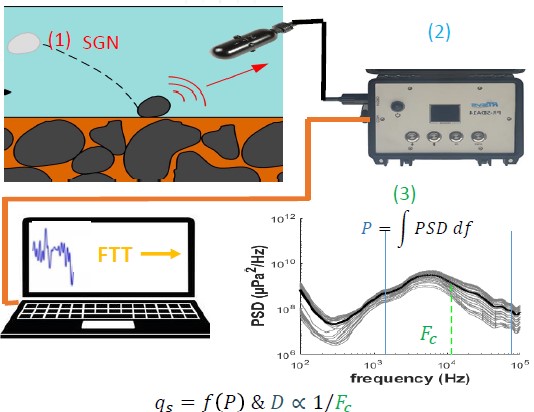
Some physics : SGN and Propagation
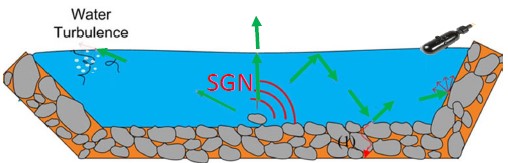
The SGN is attenuated by the propagation environment of the river (turbulence, riverbed roughness…). The propagation environment is variable from a river to another.
Continuous Bedload Flux Monitoring with fixed Hydrophones
The hydrophone is installed on the river bank and measures the temporal variation of SGN (In high-energy rivers, continuous monitoring can be optimised by coupling with geophones).
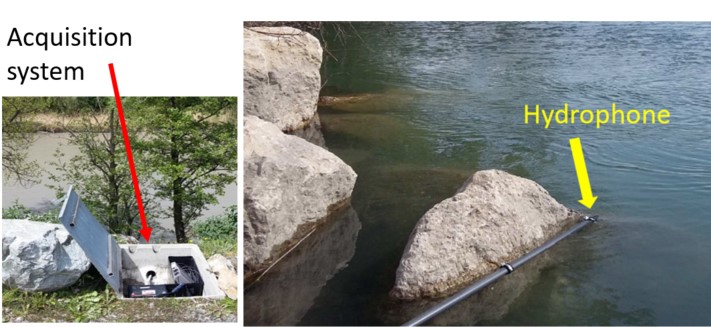
Problem : Acoustic signal measured from the bank depends on :
– the bedload location in the cross section
– the propagation environment => A calibration is needed
Acoustic Mapping
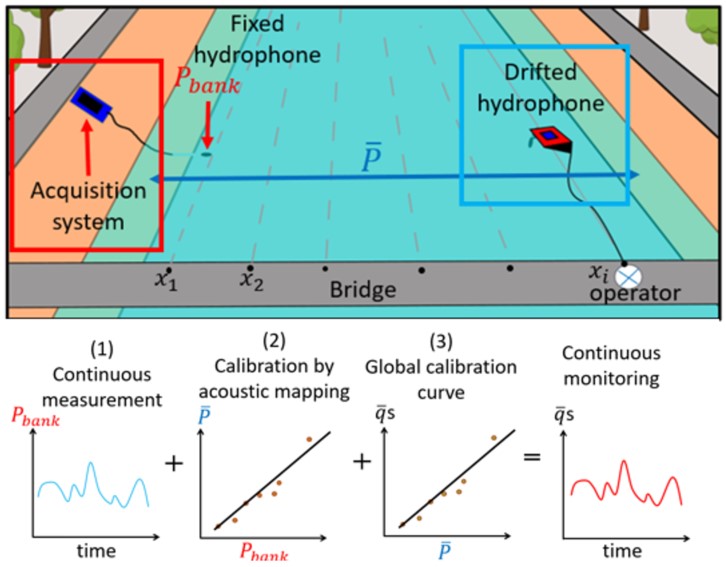
To overcome the calibration problem, we developed a methodology which reduces the geometry and attenuation limitations. It consists in measuring as close as possible from the sources with a boat drifted from a bridge (or with a flying or floating drone in large rivers). The drifted boat reduces hydraulics noices and gives the spatial distribution of SGN.
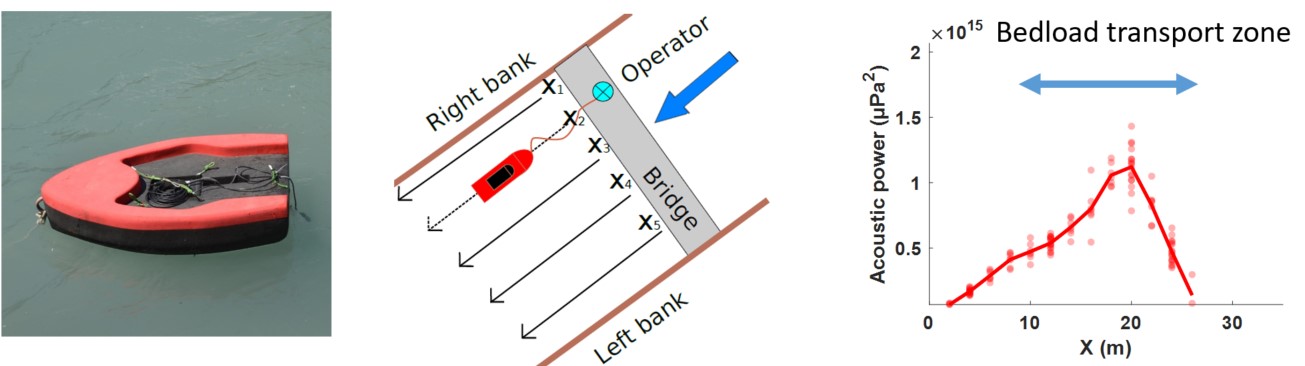
The acoustic mapping protocol allowed to calibrate the passive acoustic signal with direct bedload measurement (using Elwha and Toutle samplers) in 17 French rivers (including alpine gravel bed rivers, but also large sand bed rivers), leading to a unique calibration curve.
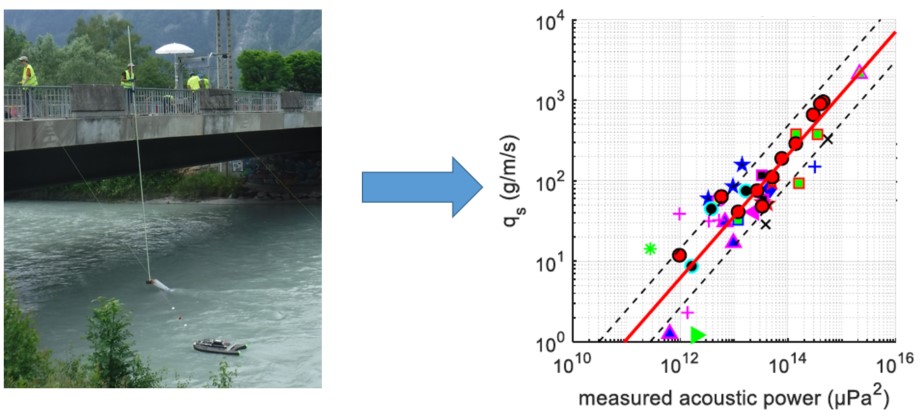
Using this calibration curve permits to convert any boat-acoustic mapping into a cross section average bedload flux, without the need to deploy traditional samplers.
Calibration of continuous bank monitoring with acoustic mapping
The global calibration curve (3) allows to calibrate the continuous bank measurements (1) of any rivers by acoustic mapping (2) to obtain continuous measurement of bedload.
Publications
Geay, T., P. Belleudy, C. Gervaise, H. Habersack, J. Aigner, A. Kreisler, H. Seitz and J. Laronne (2017). "Passive acoustic monitoring of bed load discharge in a large gravel bed river." Journal of Geophysical Research : Earth Surface.
Geay, T., Michel, L., Zanker, S., and Rigby, J. R. (2019) : Acoustic wave propagation in rivers : an experimental study. Earth Surface Dynamics, 7 (2), 537–548, doi : 10.5194/esurf-7-537-2019.
Geay, T., S. Zanker, C. Misset and A. Recking (2020). "Passive Acoustic Measurement of Bedload Transport : Toward a Global Calibration Curve ?" Journal of Geophysical Research : Earth Surface 125(8) : e2019JF005242.
Le Guern, J., Rodrigues, S., Geay, T., Zanker, S., Hauet, A., Tassi, P., Claude, N., Jugé, P., Duperray, A. and Vervynck, L. (2021) : Relevance of acoustic methods to quantify bedload transport and bedform dynamics in a large sandy-gravel-bed river ; Earth Surface Dynamics, 9, 423-444, doi : 10.5194/esurf-9-423-2021.
Misset, C., A. Recking, C. Legout, M. Bakker, N. Bodereau, L. Borgniet, M. Cassel, T. Geay, F. Gimbert, O. Navratil, H. Piégay, N. Valsangkar, M. Cazilhac, A. Poirel and S. Zanker (2020). "Combining multi-physical measurements to quantify bedload transport and morphodynamic interactions in an Alpine braiding river reach." Geomorphology.
Nasr, M., T. Geay, S. Zanker and A. Recking (2022). "A Physical Model for Acoustic Noise Generated by Bedload Transport in Rivers." Journal of Geophysical Research : Earth Surface 127(e2021JF006167).
Nasr, M., A. Johannot, T. Geay, S. Zanker, J. Le Guern and A. Recking (2023). "Optimization of passive acoustic bedload monitoring in rivers by signal inversion." Earth Surf. Dynam. Discuss. 2023 : 1-27.
Nasr, M., A. Johannot, T. Geay, S. Zanker, J. Le Guern and A. Recking (2023). "Passive Acoustic Monitoring of Bed Load with Drifted Hydrophone." Journal of Hydraulic Engineering 149(7) : 06023003.
Petrut, T., Geay, T., Gervaise., C., Belleudy, P., and Zanker, S. (2018) : Passive acoustic measurement of bedload grain size distribution using self-generated noise, Hydrology Earth System Sciences, 22, 767-787, doi : 10.5194/hess-22-767-2018.