Last news


Deep insights into the Arctic of tomorrow
Published on February 16, 2022
Interdisciplinary results of MOSAiC drift published

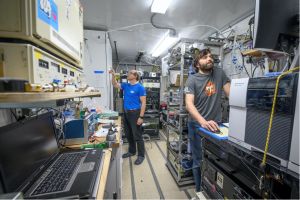
Hundreds of international researchers are currently analyzing observations from the one-year MOSAiC expedition, during which hundreds of environmental parameters were recorded with unprecedented accuracy and frequency over a full annual cycle in the Central Arctic Ocean. They have now published three overview articles on the MOSAiC atmosphere, snow and sea ice, and ocean programs in the journal Elementa, highlighting the importance of examining all components of the climate system together. These results present the first complete picture of the climate processes in the central Arctic which is warming more than two times as fast as the rest of the planet - processes which affect weather and climate worldwide.

Read more

New Atlas Finds Globe’s Glaciers Have Less Ice than Previously Thought

Published on February 07, 2022
Findings on glacier speed and depth revise outlook for freshwater availability and sea level rise.

The first atlas to measure the movement and thickness of the world’s glaciers gives a clearer, but mixed picture of the globe’s ice-bound freshwater resources, according to researchers from the Institute of Environmental Geosciences (IGE) and Dartmouth College.

Read more

In the West-African Sahel, extreme rainfalls are becoming more intense

Published on February 01, 2022

The Sahelian rainfall regime has a well tempered character : the glitz of the 1950s and 1960s was followed by a drought of unprecedented magnitude in the world in the 20th century, impacting the region for more than twenty years. Over the past 35 years, annual rainfall has gradually increased, but something has changed : "it never rains but pours"..
In this study we attempted to find out whether "extreme" rainfall events have undergone significant changes during this recent period, based (…)

Read more

Climate and floods : an international study conducted in the European Alps sheds light on the links between warmer periods and floods

Published on January 28, 2022

An international team, lead by researcher from Institut des géosciences et de l’environnement de Grenoble (IGE/OSUG – UGA/Grenoble-INP-UGA/CNRS/IRD), has studied lake sediments and reconstructed flood records during the cold and warm periods of the Industrial Era, the last millennium and the Holocene. The results of this paleohydrological study, which will be published in Nature Geosciences on 27 January 2022, show that regionally the flood hazard could globally decrease with climate (…)

Read more

Hope for Present-Day Martian Groundwater Dries Up

Published on January 25, 2022

Liquid water previously detected under Mars’ ice-covered south pole is probably just a dusty mirage, according to a new study of the red planet led by researchers at The University of Texas at Austin.
Scientists in 2018 had thought they were looking at liquid water when they saw bright radar reflections under the polar cap. However, the new study published Jan. 24 in the journal Geophysical Research Letters found that the reflections matched those of volcanic plains found all over the red (…)

Read more

Artificial intelligence helps scientists better predict glacier evolution in response to climate change

Published on January 25, 2022

Glacier mass is currently being lost due to human-induced climate change. It is extremely important to understand the physical processes related to these regional and global changes in order to anticipate possible future glacier developments and their impacts on sea level rise, water resources and ecosystems. To address these issues, numerical models allow scientists to simulate, in a simplified way, the evolution of glaciers for entire regions or over the entire planet, both for past and (…)

Read more

Antarctica : Beyond Epica exploring the climate of the past

Published on November 30, 2021

The first ice core drilling campaign of Beyond Epica-Oldest Ice is starting at Little Dome C, in Antarctica. This international research project is funded by the European Commission with 11 million euros and it is coordinated by the Institute of Polar Sciences of the Cnr (National Research Council of Italy). The project aims to obtain information on the evolution of the temperatures and on the composition of the atmosphere 1.5 million years ago, by analysing the ice cores that will be extracted from the deep ice in Antarctica. These data will be invaluable for predicting future climate trends and for implementing mitigation strategies

Read more

InterAcademy Partnership (IAP) Statement : Climate Change and Biodiversity : Interlinkages and policy options

Published on November 22, 2021

Climate change and biodiversity decline are major challenges of our time. Both are mainly caused by human activities, with profound consequences for the people and ecosystems on which we depend.
In 2021 and 2022, the major UN conferences on biodiversity (COP15) and climate change (COP26) will be held, providing an opportunity for governments to draw international attention to the interconnection between climate change and biodiversity. However, this is not guaranteed and some climate (…)

Read more

A project with participation of IGE receives €8 million from the EU to improve air quality monitoring in Europe

Published on October 27, 2021

The RI-URBANS project will focus on nanoparticles and atmospheric particulate matter, their sizes, constituents, sources and gaseous precursors It seeks to implement new service tools that contribute to improving air quality in European cities
Grenoble, October 27, 2021. The European Commission funded project, RI-URBANS, has been officially launched with the aim to provide advanced service tools from atmospheric research infrastructures to better assess the air quality in Europe. (…)

Read more