The federation
 Intranet


When Antarctic icebergs get stuck on the seabed : why it matters for climate
Slider image credits : Anna Olivé Abelló
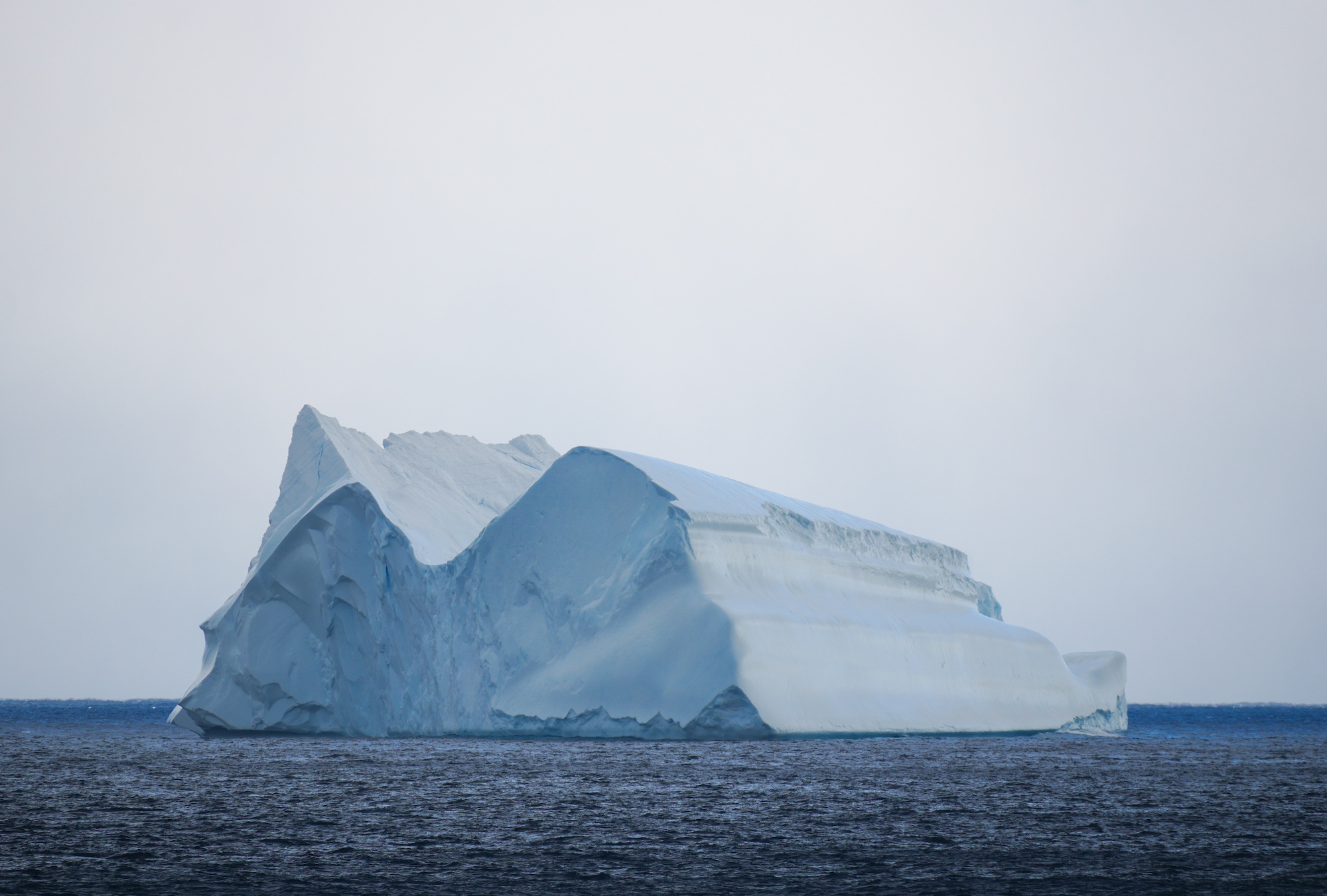
and the South Orkney Islands in March 2025. Credits : Anna Olivé Abelló, IGE
Antarctic icebergs are huge ice blocks that break off from glaciers and floating ice shelves and drift through the Southern Ocean. As these icebergs melt and release freshwater, they modify the global ocean circulation and therefore the global climate.
Icebergs also transport sediments and nutrients that fertilise the Southern Ocean, support phytoplankton growth, and indirectly help remove carbon dioxide locally from the atmosphere, playing thus an essential role in Earth’s climate. Because of these multiple roles, icebergs need to be represented in numerical climate models to accurately simulate the ocean evolution and environmental conditions in a changing climate.
Icebergs thicker than previously thought
For more than a decade, iceberg numerical models have simulated the trajectories and melting of individual icebergs. However, they have relied on the assumption that Antarctic icebergs are no thicker than about 250 m, based on reports from a small number of cruises.

Satellite images have since revealed that massive icebergs get grounded on ridges deeper than 400 m, indicating that much thicker icebergs exist. A great example is iceberg A23a that had a thickness reaching nearly 400 m on one side, and remained grounded in the Weddell Sea for more than 30 years before melting and resuming its path in the so-called iceberg alley.
In a new article, an international research team led by scientists from the Institut des Géosciences de l’Environnement (IGE) proposes that icebergs inherit the thickness from the ice-shelf front where they are formed, resulting in iceberg thicknesses of up to 680 m, far greater than previously assumed.
More meltwater released around Antarctica
This new representation has been coded in a numerical ocean-iceberg model, allowing thick icebergs to be blocked by shallow seabed ridges. After these model developments, numerous simulated icebergs get stuck on the shallow seabed, with about the 9% grounding at depths between 400 and 550 m, increasing their average residence time near the ice sheet. This causes icebergs to release 30% more meltwater on the continental shelf surrounding Antarctica.
These changes in melt distribution have significant regional consequences for the Southern Ocean as they increase the stratification and reduce the vertical mixing, isolating the dense deep and relatively warm waters from the colder, fresher surface layers. This tends to promote the intrusion of warm water towards the base of Antarctic ice shelves and accelerate their melting. Additionally, these grounded icebergs tend to anchor drifting sea ice, acting as a barrier that accumulates thick sea ice eastward and maintains open water westward. Being able to reproduce the presence or absence of sea ice is crucial for reliable and accurate climate simulations.
When icebergs get grounded on seabed
An important limitation of this first study is that the interaction of icebergs with the seabed is represented in a very simple way in the numerical model, because there was no theoretical background on the physics of this interaction.
In a second article, researchers from the British Antarctic Survey and IGE present new insights into the formulation of the momentum equation of an iceberg that is getting grounded. In particular, they describe the bottom sediment resistance and the friction with the solid bedrock below, as well as the gravity effect on icebergs that are pushed above their flotation level. Observations of scours left by previous icebergs on the seabed have been used to calibrate the representation of sediment resistance.
This more comprehensive representation of iceberg grounding processes will allow the investigation of how long icebergs remain grounded, and whether a warmer climate will lead to more or fewer grounded icebergs around Antarctica.
References :
1. Olivé Abelló, A., Mathiot, P., Jourdain, N.C., Kostov, Y., Holland, P. R., Gascoin, S., & Rousset, C. (2025). Iceberg grounding enhances the release of freshwater on the Antarctic continental shelf. Journal of Geophysical Research : Oceans, 130, e2025JC022857. https://doi.org/10.1029/2025JC022857
2. Kostov, Y., Holland, P. R., Hogan, K. A., Smith, J. A., Jourdain, N. C., Mathiot, P., Olivé Abelló, A., Fleming, A. H., and Meijers, A. J. S. : Modelled dynamics of floating and grounded icebergs, with application to the Amundsen Sea, The Cryosphere, 20, 135–169, https://doi.org/10.5194/tc-20-135-2026, 2026.
Scientific contact : Anna Olivé Abelló
Author : Anna Olivé Abelló
Edition : Anne Chapuis
15/01/2026
This research was supported by Ocean Cryosphere Exchanges in ANtarctica : Impacts on Climate and the Earth system, OCEAN ICE, which is funded by the European Union, Horizon Europe Funding Programme for research and innovation under Grant 101060452, 10.3030/101060452. This work was funded by UK Research and Innovation (UKRI) under the UK government’s Horizon Europe funding Guarantee, Grant 10048443. Furthermore, this study has received funding from Agence Nationale de la Recherche—France 2030 as part of the PEPR TRACCS programme under Grant ANR-22-EXTR-0008 (IMPRESSION-ESM) and ANR-22-EXTR-0010 (ISClim).