 The federation
 Intranet


Many densely populated regions likely to become drier during the 21st century

Climate change and aridity : a threatened balance for vulnerable areas
About one-third of the world’s population lives in drylands, regions where water is naturally limited. Climate change is not only increasing temperatures, but also altering rainfall patterns. These two phenomena are altering the balance between available water and the water needed for ecosystems, agriculture, and human societies to function. In arid areas, this balance is particularly delicate due to the already high pressure on water resources.
In an article recently published in HESS, a research team attempted to identify regions where the balance between water availability and water needs is likely to change in the future. This study was carried out in collaboration with Arona Diedhou, a researcher at IRD and affiliated with IGE, and the Science-Policy Interface team of the United Nations Convention to Combat Desertification, in which IGE participates in conjunction with LMI NEXUS.
Future projections : which regions will be most affected ?
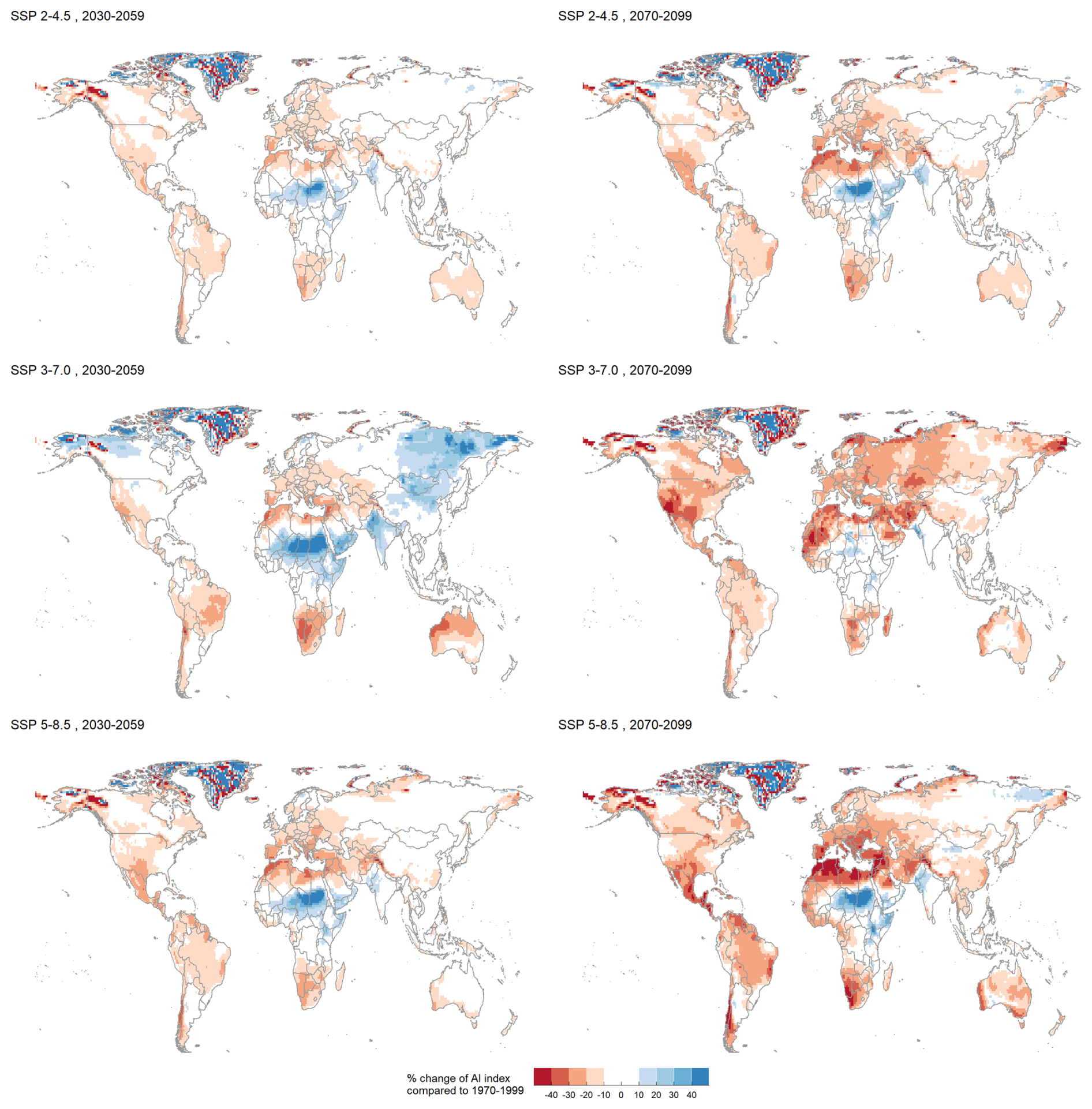
To determine how dry or wet a region is, this study uses the aridity index. This index compares the amount of precipitation received in a given region to the amount of water lost through evaporation or plant transpiration. The lower the index, the drier the conditions. The analysis covered the entire globe and is based on the average aridity index (reference period 1970-1999) and its future projections for the periods 2030-2059 and 2070-2099. Three common socio-economic trajectories (SSPs) are used : SSP 2-4.5 corresponds to an overall temperature increase of around 2.5°C by 2100, SSP 3-7.0 to around 4°C, and SSP 5-8.5 to around 5°C (temperature increases relative to the period 1850-1900).
In all three SSPs, the projected aridity index shows that many densely populated regions are likely to become drier during the 21st century, regardless of the future climate trajectory. The strongest drying is projected in the Mediterranean region and Central America. Water resource constraints will not only affect regions currently classified as arid, but also regions currently considered humid or temperate, such as Northern Europe. In contrast, parts of the Horn of Africa and western India are expected to become wetter, likely due to changes in monsoon patterns.
A temporary paradox in the SSP 3-7.0 scenario : humidification before drying out
An additional interesting result emerged for the SSP3-7.0 scenario. In the mid-term projections, we observed a limited decrease of aridity index and an increase in wetness in India and North-East Asia. This trend is reversed in the long-term projections, where drying climatic conditions are widespread. This medium-term effect is explained by high aerosol emissions in this scenario, which promote more intense precipitation.
This study was conducted on a global scale with relatively coarse resolution. At the local level, the impacts of climate change are much more diverse. However, such a study highlights areas where the risk of aridification is highest and where adaptation needs are most urgent.
References :
Crapart, C., Anquetin, S., Blanchet, J., and Diedhiou, A. : Global projections of aridity index for mid and long-term future based on CMIP6 scenarios, Hydrol. Earth Syst. Sci., 30, 163–181, https://doi.org/10.5194/hess-30-163-2026, 2026.
Scientific contact : Camille Crapart
Author : Camille Crapart
Editing : Anne Chapuis
January 27, 2026