 The federation
 Intranet


Listening to glaciers to monitor their (in)stability
Credit slider photo : E. Le Cornec
From slow motion to sudden acceleration
Based on unique measurements made over several years, an international group of scientists documented in a new study the speedup of an Arctic glacier, from a few meters per year up to almost a hundred meters per year, and identified the underlying mechanism. For the first time, they directly observed how climate change can trigger a transition from stable to unstable glacier flow, previously thought to be unrelated to external drivers.
To understand how this transition occurs, the study focuses on Kongsvegen glacier, one of the best-studied glaciers in the Arctic, thanks to its close location to the Ny-Ålesund research station in Svalbard (79N). This glacier is a so-called surge-type glacier. Such glaciers are known to exhibit years to decades of very slow flow, interrupted by short episodes of rapid acceleration (“surges”), with flow speeds increasing by orders of magnitude, often accompanied by significant front advances.
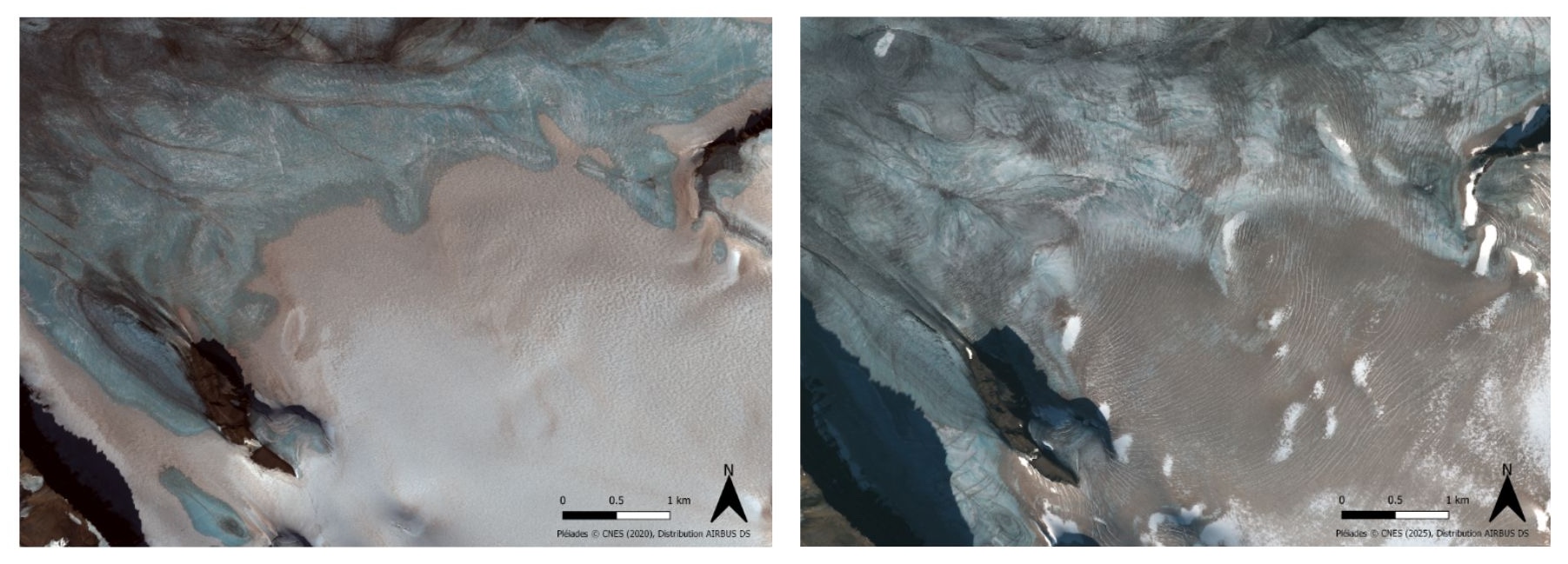
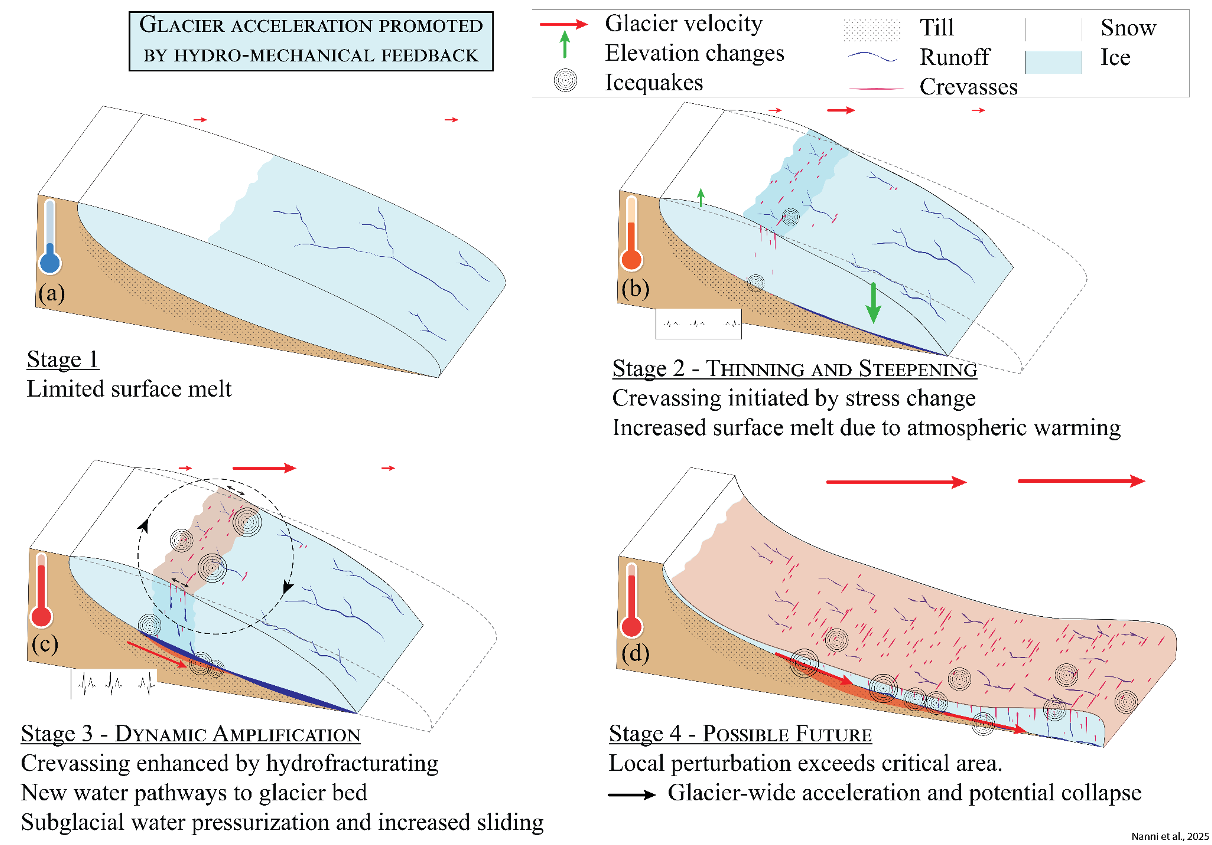
Leveraging several decades of monitoring, the study uncovers a feedback mechanism by which an initial glacier acceleration is amplified through more widespread ice crevassing which in turn provides new entry points for meltwater to reach the base of the glacier ; where water lubrication causes the glacier to slide faster. If this acceleration propagates to the entire glacier, the long-term mass loss of the glacier will be intensified by the more efficient transport of ice from higher areas towards the glacier front.
A warming Arctic and growing stability concerns
The study takes place in Svalbard, where atmospheric warming is almost seven times faster than the global average. A recent study (Schuler et al., 2025) showed that the extreme melt during the summer 2024 was not predicted to occur before the second half of this century. Given the rapidly increasing meltwater production, a crucial question then becomes : beyond mass loss, what does this increasing melt do to the stability of glaciers ? With the recent rise in glacier detachments, mountain slope failures, and disasters caused by proglacial lake outbursts worldwide, it is important to understand whether glaciers are becoming more unstable, and if so, how such processes can be observed or monitored. Furthermore, dynamic flow instabilities increase the contribution to sea-level rise, beyond that of the increased meltwater production.
Listening to ice : combining long-term observations and seismology
This study exploits an exceptional combination of long-term data and high temporal resolution observations using several different methods. Over 20 years of measurements of glacier flow speed based on surveying glacier mass balance stake positions are complemented by repeated satellite observations that track the evolution of surface crevasses, and measure glacier thickness changes at high resolution.
The key source of insight is from a seismic network operated on the glacier since 2018. In addition, several seismic sensors installed within the ice, 250 m below the glacier surface, enabled the detection of seismic activity originating from within the ice and close to the base of the glacier. Just as in earthquake science, scientists used seismic stations to “listen” to the glacier as it slides along its bed, making cracking and scraping sounds.
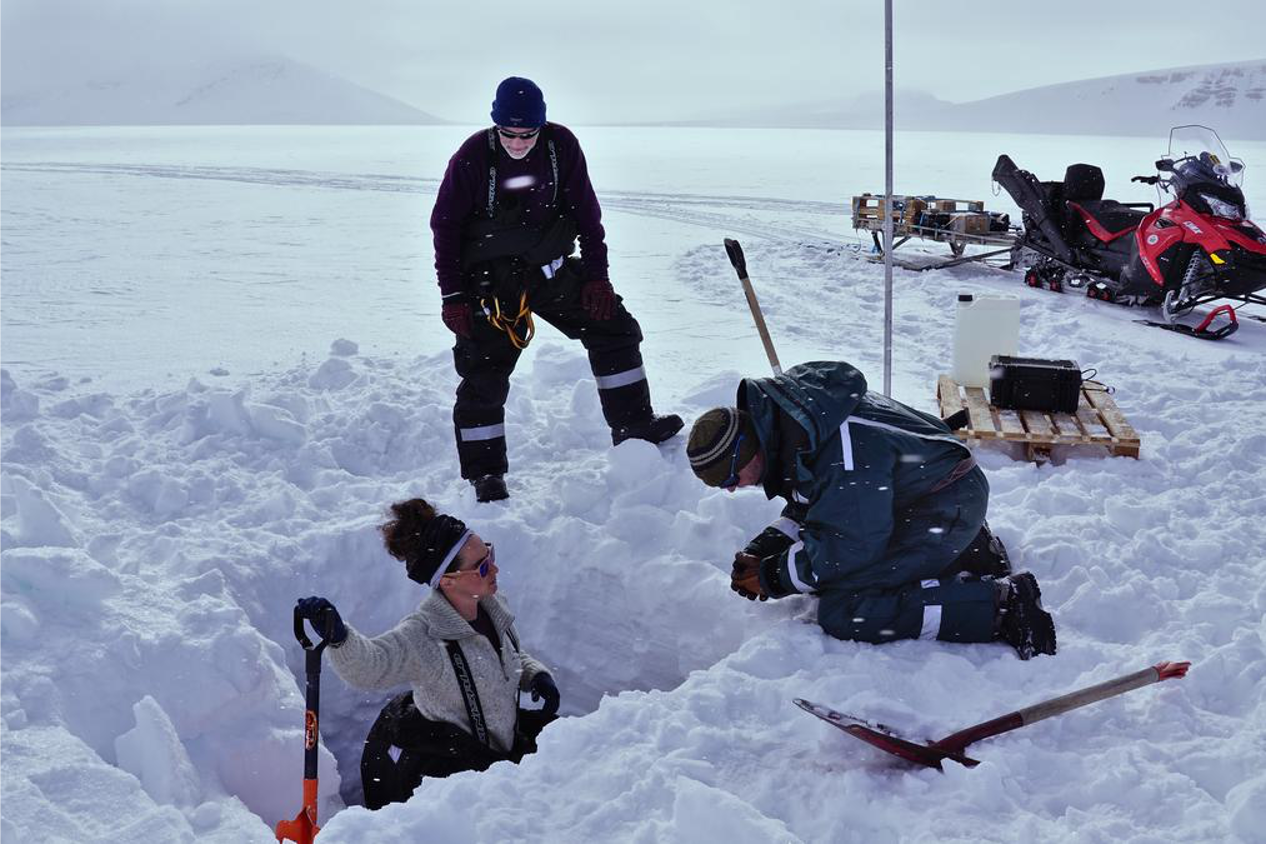
The dataset allowed scientists to track how cracks in the glacier appeared, grew and deepened, to detect when and where meltwater started entering them, and to identify when meltwater reached the glacier base and influenced glacier sliding. The chain of effects leading to the multi-year increase in glacier sliding in response to surface melt was identified by this unique combination of deep and surface seismology, together with the long time series of velocity measurements and glacier geometry changes.
Implications for glacier hazards and future projections
The observed mechanism has already led to a dramatic, more than ten-fold acceleration of Kongsvegen. This raises important implications : A meltwater-driven destabilization mechanism means that climate change does not only impact glaciers through surface mass changes but also through dynamic instabilities that can propagate over large distances inside the glacier and lead to its acceleration. Svalbard, because of its amplified warming, gives us an early preview of what could happen in other glacierized regions as temperatures continue to rise.
Results also show that seismology is a powerful, relatively low-cost tool to monitor these instabilities, even in remote areas. This opens avenues for early detection of glacier hazards and for better understanding how glaciers might transition into unstable regimes in the future. As melt continues to increase and reaches higher elevations, similar processes may emerge in many other glaciers, potentially altering their behavior much earlier than previously expected.
Researchers have directly observed how crevasses form, how surface meltwater penetrates to the glacier bed, and how it affects glacier sliding. These processes have thus far not been well represented in physical models of glacier flow, if at all. Those observations thus provide much-needed new information that can help improve models used for assessing the risk of future glacier hazards and instabilities in a warming climate, as well as projections of future sea-level rise.
Local scientific contacts :
Ugo Nanni : nanni uio.no, ugo.nanni univ-grenoble-alpes.fr +33 6 43 29 31 41
Olivier Gagliardini : olivier.gagliardini univ-grenoble-alpes.fr
Reference : Nanni, U., Bouchayer, C., Åkesson, H. et al. Observed positive feedback between surface ablation and crevasse formation drives glacier acceleration and potential surge. Nat Commun 16, 11227 (2025). https://doi.org/10.1038/s41467-025-66349-9
Author : Ugo Nanni
Edition : Anne Chapuis
06/01/2026